Wednesday, 8 January 2014

The Problem with Princesses

Well, I just got round to the frankly rather irritating task of hand-washing the Girl's princess dresses. Actually, I did it in two batches (small house, and they all need to air-dry), but still. 

All fancy dress outfits these days require hand-washing, which isn't really the issue for me. Fill a bowl in the sink with water, squish them in one at a time, and there you go. But afterwards, with two dresses scrunched on my draining boards awaiting hanging space in the shower (these things drip forever, I swear), I got to thinking.

I just washed away a swirl of glitter from one of these dresses, from a pattern glued onto the fabric. It looked lovely on the shelf, but I am all too aware that its days are numbered. When the glitter is gone, it will look a lot more shabby. 

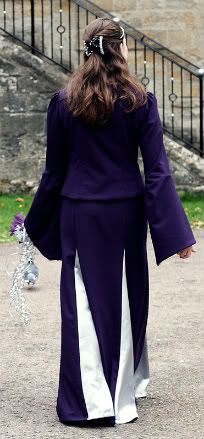
Yes, sharp-eyed parents of Rapunzel fans may know that the purple dress
is technically sponge-clean only but, that didn't work. It never does.

Most of her other dressing-up garments are similarly fragile. I gently tease the marks out of the polyester, because they are too fragile to go in the washing machine. That said, there is so little natural material in these dresses that everything comes out with remarkable ease. I mean, even tomato stains rinse right out.

Still, I look at her little collection of dresses, all about £15 a go, and wonder at the point of it all. None of them can stand up to thorough use - they all rely on little girls playing princess tea-parties and practising curtseys no doubt - but the Girl has a big brother, and a rather more enthusiastic streak. She is the Princess with a Light Sabre, or a Princess with a Sword (even if the "sword" is actually one of my scarves). 

She's going to ruin the dresses long before she outgrows them. And, while I'm totally on-board for the sword fighting, I can't help but think it's a shame that her make-believe clothes can't stand up to her make-believe ambitions. And seeing as I have a sewing machine, I've gotten to wondering if there isn't something I can do about that. 

This grand scheme may all come to naught. But I'm definitely going to look into what I can do to make a sturdier dress that won't rub off all over my sofa (seriously, there is purple glitter everywhere from this latest dress), and will let my daughter be the Sword-Fighting Princess she is in her head. Maybe I can even give it a scabbard. 

Watch this space, eh?

Friday, 3 January 2014

The Tea is Taking Over

I sometimes joke that I "live on tea". It's an obvious exaggeration, something I jest about as I make cup number six of the morning. Still, it has the ring of truth about it.

I know from past experience that if I don't drink at least one cup of everyday tea in the morning, by the afternoon a bit of caffeine withdrawal has begun to kick in, and I'll have a headache. I'm happy to stand up and admit my caffeine addiction - at present and for the foreseeable future it's a relatively benign one.

For me though, tea goes beyond just a caffeine hit in the morning to wake me up, or to stretch out a long evening. I did a mini-stocktake earlier and discovered that in my cupboards I have twenty-one different varieties of tea, four of which I have in both teabag and loose-leaf form.

I even made a handy (and totally not-weird) list which I stuck to my kitchen wall. 

If you deciphered my handwriting, or if you don't care, you can skip this next paragraph, because I'm going to list them all:

Everyday (+L); Rosehip; Breakfast (L); Cardamom; Earl Grey (+L); Rooibos, Green (+L); Morocco (Mint + Spice); Peppermint (+L); Cinnamon; Chamomile; Lemon; Lemon + Ginger; Jasmine (L); Apple + Cinnamon; Gunpowder (L); White tea with Elderflower; Green tea with mango and lychee; Blackberry blueberry + and acai; Cranberry Raspberry + Echinacea; Strawberry + Loganberry. The "L" stands for loose leaf.

I also keep a jar of instant coffee for visitors to drink, along with sugar and sweeteners. None of these three things are used by myself.

After totting it all up and writing it down, I got to thinking. Why do I keep so many varieties? Why do I drink so much tea, too? It's not just the caffeine hit, because most of the listed blends don't contain any particularly measurable quantity of the stuff.

When I was a girl, I can remember knowing that children had squash or water, and grown ups had tea. It was How Things Were. My family were not great consumers of alcohol, so I didn't see them with a glass in hand. No, it was a mug. It was: "Oh, I'm gasping, put the kettle on!" When my mum (dash of milk, no sugar) visits, often first thing she does after the hello-and-hug is to ask for a cuppa.

To this day I consider it a matter of genuine embarrassment if I fail to remember how people take their tea (or if they prefer coffee), or worse, if I forget to offer to put the kettle on at all. It's a social conditioning, a habit which I inherited, and which already the Boy and the Girl are mimicking, holding tea parties for their teddies.

It's a comfort too; a ritual which precedes writing sessions. Do I make a pot, or use a bag in a cup? Do I need the caffeine in the evening, or do I want to relax with chamomile? I have two teapots, a selection of large mugs, and a set of Cath Kidson teacups which are a treasured present from my Dad (milk, one sugar).

If I really want to get into writing, and I have the time, I make a point of getting out my little teapot and making tea with leaves. I set out the pot and strainer at a safe distance from my laptop, and refill when necessary. It breaks up the writing, allowing me to collect my thoughts now and then. I've gotten to the point where I associate certain flavours of tea with certain times of day, or occasions.

Everyday tea is for general drinking. A cup (or preferably two) to wake up with in the morning, and then a steadyish stream throughout the day. Early Grey is for a change, or when I run out of milk. Lemon and Ginger is for when I have a cold, and my various flavoured teas are for the evenings mostly, when the children are in bed and I can sit back and drink without the danger of it going cold without my noticing.

As for why I have so many? Well, if the fact that I located another flavour while writing this (Lemongrass and Ginger, if you're interested) is anything to go by, it could be that I enjoy a wide range of flavours to suit my moods. It could be that I keep a wide range out of habit, to account for visitors and their preference. Or, more simply, it could be that as much as I am addicted to tea, I am also very good at buying it and then losing track of where I've put the boxes afterwards.

As a writer though, I think I'm going to keep telling people it's because I'm creative and eccentric. We all need our little oddities, don't we?

Wednesday, 18 December 2013

'Tis the Season...

...To be piling on the anxiety, it seems.

I'm like it every year - every season, really, but particularly Christmas it seems, because there's so much to worry about. Gifts to buy, and to wrap, cards to write and send, and now school events to remember, attend, send cakes/money for, and friends to consider.

And as someone who dislikes crowds due to social anxiety, even popping to the shops for a pint of milk can become a little daunting. I get home and want to curl up on the kitchen floor with a cup of tea, reassuring myself that I don't have to go out again. Or I would, except that I do have to go out, because if there's one thing I can rely on at Christmas, it's that the stress of trying to be on top of things and remember everything will lead to me in fact forgetting more than usual.

So far, I have written half of my Christmas cards and posted none. And as I type this, I realise I went shopping earlier (with the Girl in tow) and despite writing "stamps" on the list, forgot to buy any. So that will be another trip out. Tomorrow, it can be tomorrow, and I'll suck up the price of a first class stamp, sighing with relief that due to a bit of travelling around, I only actually have to post three or four cards this year. Or five. Could be five. Either way, hooray for not having a lot of casual friends, eh?

I'm riding the adrenaline rush at the moment and hoping the seizures don't happen at the wrong time. I had two yesterday, and both fortuitously managed to be when my children were at school/pre-school and then asleep. I gloss over the note of fear which whispers into the back of my mind that one day, surely, the law of averages will spring one on me at a bad time. It's a chiming worry which I never listen to, apart from late on those nights when sleep eludes me, and if I were a child again I'd want to turn to the comfort of a parent to reassure me that all is well.

That's the thing about adulthood. I have to smile and reassure my children; all the while I'm fighting the urge to call my own parents and ask them the same thing. The single-parenting aspect gives me so much freedom - I went into town today straight from school and stayed there until I wanted to come home instead of rushing back, feeling as though time were ticking away - but the counter to that freedom is the anxiety that I'm an army of one. Help is on hand, but it's a hand several miles away, to be summoned by a phone I can't always use.

And for every person who helps me, I feel the nagging tug of an obligation to be repaid. A debt I owe, one which mounts with each and every favour I offer to repay in kind but never quite settle to my own satisfaction. Then looms Christmas, and I settle it on myself to repay at least a little with gifts and cards. Gifts and cards which must be bought, prepared, and given. All added stresses which I balance on my scales, adding and subtracting what I can do and what I have to let go. And for the let-gos, do I rush to catch up later, or call for help? My cycle of anxiety grows and multiplies.

Yes, 'Tis the Season. To be Merry, to be Festive, and to smile brightly, all the while I am masking wishes for it to all be over so that I can try and find some time to catch up on the things I have not done, the things I forgot, and the favours I am sure to owe in the New Year.

Tuesday, 17 December 2013

Christmas concerts have changed.

So, today was my son's Christmas Carol Concert. Now that he's in year 1, and no longer in the semi-partitioned world of Foundation, he gets to participate with the rest of the school. I'm writing this, feeling like I've crossed over the threshold into the mythical world of the "School mum". As though last year and the weeks of this one so far didn't count.

Still, this is the first time I have felt compelled to write about something specifically and only relating to my children on here. So maybe that is a rite of passage of sorts.

You see, I was a little sceptical about the children having only a "carol concert", and no nativity once they were out of Foundation. I'm no practising Christian - I'm thoroughly agnostic with a logical leaning for much of the time, but I guess I can be pretty traditional about some things. And there's something nice, isn't there, about trotting out to see your precious child say nothing at all in the school play while the children of the more prominent PTA members get to be Mary and Joseph. (The highlight of my Nativity experience was being a rag doll in Santa's workshop, captured for milliseconds on gloriously blurry VHS.)

That was how it was done, right? When I was at school, costumes were home-made and nigh unrecognisable. You sang Away in a Manger tonelessly and raggedly, while the teacher who could play the piano trotted out her repertoire on an upright which was only a little out of tune. And there was a good chance the parents could understand at least one word in three of Silent Night.

This year, I sat near the back of a hall at the neighbouring secondary school, watching my son stand with his year group singing a song about Christmas crackers, after which they marched off the stage to let the next year on. There was no piano - instead, a very polished CD was played which the children sang along to, and tried to be as loud as the rather more in-tune children's choir it featured. It was a lot more slick and jazzy, but somehow, I couldn't help feeling as though something had been missed.

The only year group which do a Nativity at my son's school are Foundation. Well, last year the Boy was sick on the day we were to go and see it, so I was unable to see his performance as a "Non-talking Shepherd", and it looks as though that was my only shot. maybe it's just my bitterness at missing his one and only Nativity, but I can't help feeling that sitting children in rows so they can sing along to a bunch of other (no doubt older) children singing better than they can is slightly missing the point.

I don't go to a primary school carol concert looking for polish and quality. I go to see my son, and as much as it might make me a bad person, I don't care about the other five years, all singing in turn. Or even watching 360 children standing in a group singing a song I have heard a rather more flat version of at home for the last fortnight. Especially when I know that I'm not hearing him anyway. I'm listening to a CD, played out on speakers because 360 children means a whole lot of parents and the borrowing of a secondary school's hall to accomodate them.

Call me old-fashioned, but I think I would have preferred what my parents got. An out of tune piano and a rag-tag of children who sing their off-key hearts out, missing or forgetting words and generally sounding like what they are. Children. Our children.

When did it become the done thing to replace their (let's be honest, not very good) singing with the singing of some other people's children?

Wednesday, 4 December 2013

Problems with being Socially Anxious

I don't do people. I don't have a massive problem with them or anything, although large crowds tend to set shivers down my back and have me watching over my shoulder every now and then as though someone is about to run up behind me and plant some sort of: "I look really stupid, please laugh at me" sign on my back. 

Pictured: My trusty shield, defending me from imaginary "kick me" notes for a good decade or so.
It was once an indispensable part of my wardrobe. 

But largely. I can manage. I can walk next to people without freaking out. I might even make small talk with other parents outside the school gates after I've "known" them for six months or so. Heck. After the Girl had separation anxiety and used to go, screaming, into pre-school every day, I perfected the: "Oh well, it's just a phase," line as I forced a smile onto my face while walking past all the other parents with their not-screaming children, hoping that they weren't judging me, mocking me, or despising me for being responsible for such a noisy child. (And thankfully the Girl has gotten over her own anxiety and is quite happy in the mornings now.)

I will readily admit that as much as I try not to label myself, the terms "shy", "social anxiety" and "people phobia" spring readily to my mind when I think of my personality, along with somewhat more stigmatising terms such as "recluse", and "social pariah".

For the most part, I live my somewhat solitary life more vicariously through the internet. Here, at last, I am free, cut loose from my anxieties because no one can see how my forehead contorts with nerves as I post on forums. No one knows that I sit for five, ten, fifteen minutes with my mouse hovering over "reply" - all they see is TottWriter, a name on a screen, sounding confident, opinionated, bold. Even if the name does post somewhat infrequently.

Parenting puts a bit of a dampener of that shield, however. There's the school run, for starters, And while it's less daunting in reality than lots of forum topics would make it out to be (I've yet to see the parents actually divide into tribal formations, taking out the weaker specimens for sport), it still involves a degree of social interaction which I flounder on at times. Left to my own devices I would walk alone, stand alone, collect my children and flee, feeling pangs of longing for the parents who natter and gossip with ease, but knowing it's not for me.

Then, the Boy went and made friends, and suddenly we have a group of people to walk to and from school with each day. I've taken to calling bedtime "The Gauntlet" due to its somewhat challenging nature, but my true gauntlet runs twice a day, at starting times of 8:20am and 3:00pm. Here is when I am tested - when I smile and make small talk, all the while noticing every pause before someone replies to me, every time people don't hear my remark and talk over me, every time I am three paces behind the main group instead of one or two. Every occasion where the other parents are meeting up outside of school and I am not, when a grudge or conversation is discussed in which I had no part. 

In short, every time I feel that little bit more invisible than the others, when I start to worry that my mask of confidence has slipped and people can see me for what I am - an outsider, desperately clinging to the pack for my children's sake and out of loneliness.

I know I don't belong there, in conversations about nights out, fashion, and men. I'm none of those things. I stay in, I have never been fashionable, and I am currently coming to a full realisation that I am far closer to asexual than allosexual. I don't fit, and I never have. 

The problem with being socially anxious is that, even though I know that no one "fits" a group perfectly, instead of finding the common ground and building friendships. I falter at the first hurdle, and spend years berating myself for that failure, for "getting it wrong", for standing wrong, dressing wrong, staying quiet when I should have talked, or babbling when I should have been quiet. It's that I over-analyse every mistake I make and let it cloud my social interactions in the future, and although I no longer wear a rucksack and a mid-length coat to defend myself from other people, I still feel like I need to don armour every time I walk out of the house.

Monday, 19 August 2013

Farewell, Brown Envelope...

That's that then. On Friday I posted off my last DLA renewal. Here's hoping, eh?

It took me the better part of a week and cost me about six or seven seizures, not counting the one I had on the way back from posting the damn thing. That last one turned a five minute walk into almost two hours, and cost me a few pounds in impulse purchases made when I wasn't fully there. Having a seizure is like being drunk. You're not fully in control of your body, even when you can walk and talk. And that side of things can last for a good hour or so either side.

In either case, Friday was a write off for me. I came home and I was out of it for most of the remainder. Had a nightmare that night as well. I guess I can't prove causality on that one, but it's an interesting coincidence.

I had a fairly large seizure yesterday too, and another this morning. Yesterday's involved falling off my computer chair and landing head first on the floor. I jarred my left knee, and caught my right foot on one of the chair's wheely-feet. Both still hurt this morning, along with various other ouches. And then in this morning's seizure I've jarred my left shoulder.

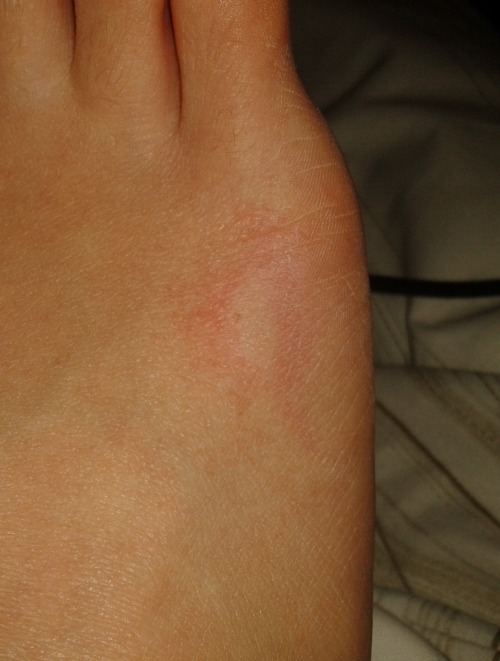
For such a tiny mark, my foot still hurts
one heck of a lot 

In essence, everything hurts, to a greater or lesser degree.

Is this my life anyway? Well, kinda. But the severity of the seizures and how close together they are (three "big 'uns" in three consecutive days, plus auras on the side) is striking. And that's *after* the form sat on my worktop for three days, complete and envelope'd, just waiting until I had a chance to post it.

It was demeaning, and horrifying, to list in detail all the things I can't do. All the dangers I can pose to myself and to O&M. All the measures I put in place to protect my family seem so frail at times. I can "manage" (at the cost of regularly injuring myself), but I take for granted having that extra money there to buy takeaway when it's not safe for me to cook and I've already used my "emergency ready meal" from the freezer. Or if I have no food because I couldn't get out to buy it.

I try to cover up the fact that there are times I will lie on the floor in the kitchen and my children will come and stand watching me for a minute before they get bored and go and play. I downplay it to friends: "Oh, I'm fine; the children are as good as gold, they know what to do."

I don't think they really know what to do at all. It's normal for them, they aren't scared. But they do poke me, or climb on me, or fail to realise I'm having a seizure. They tell me to get up, ask me why I'm lying on the floor. (Sometimes they get rather cross that I won't fetch them drinks etc.)

I gloss over those aspects on a day-to-day basis. One of the other mums has authority to collect my son from school if I don't turn up, so seizures at pick-up time can be resolved, but other than that I do all I can to not make concessions. I'm a fighter. Well. You have to be, and I'm lucky enough to come from a family of women who are stubborn as all hell anyway. I still hold that faint hope somewhere that one day I'll get my driving license back, and if that's not a faint hope in reality, I don't know what else is.

I'm a writer, I make up worlds, so my most common coping mechanism is to pretend there's nothing wrong with me all the time I can. I take risks. Last week I went to London for the evening. I spent the next day exhausted and had seizures as a result, but at least I had my fun night out.

And then, there I was, confronted with that God-forsaken form and an instruction to list, in detail, all the things I can't do. All the inhibitions on my life, all the ways that epilepsy gives me the finger on a regular basis. There's quite a few. Of the many sections, I think there were four or five, maybe six, that I could leave blank. I probably could have said more. I certainly would have said more, had I lots of consultation notes to hand in, but as it happens there's no access to specialist support here, so I don't have any. I did at least get to point that one out.

And now the wait. Fingers crossed I "pass", eh? Because I still need that DLA. Whether I meet the increasingly stringent criteria or not won't change the fact that most days, the longest I spend out of the house is an hour. In term time. Taking my son to school and picking him up.

And now that M is 3, I somehow have to start volunteering when term starts. Good old ESA, tailor-made to stretch me to the limit. Let's just hope it doesn't make my seizures worse, eh? Maybe double up on those crossed fingers. I might need the extra luck.

Tuesday, 6 August 2013

What a difference a day makes...

So. Maybe I'm about to embark upon a rant full of self-pity and unwarranted entitlement (I'm sure there are people who would assess my situation as such, so I figure I should get the warning out of the way). However, I think this is something I need to say, because the situation I'm in isn't one that is faced by me alone. It's something facing thousands, and in the spirit of Bedding Out I'm putting my private self out there because it's something not many people see. And maybe they should.

I have epilepsy. I also have dissociative seizures, which are also known as "non-epileptic seizures" "psychogenic seizures" "non-epileptic attack disorder" or whatever other flavour of the month name is going around, seeing as it's something which doesn't actually appear to have a universally recognised medical name just yet. (This is something that is oh, just super helpful when it comes to trying to manage the condition by the way.)

I'm writing this because I just got my DLA renewal form through (well, it was actually a week or so ago but other family issues intervened), and while I seem to have struck the lucky jackpot in that I fall into that thinnest of margins where I don't transition to PIP just yet, I'm also struck by how badly my current postition sets me up to claim DLA at all.

The Dreaded Form

I'll say now, my health has not notably changed from when I first made my claim in 2009 and was awarded medium care, low mobility. I've had my ups and downs, but hey. I didn't notify the DWP when my seizure frequency skyrocketed and I was having them multiple times every day. I managed with what I had, and I didn't want the stress of filling that out because, hey, while I was worse I also know that I fluctuate and eventually they'd settle back again. I'm not out to get every penny I can. I just want to be able to live.

So. Here I am now with the above forms in front of me. Back in 2009 I had help from my local CAB filling out the forms. Navigating them is daunting and intimidating. The single-purpose form covers such a vast array of illnesses and disabilities that you start to doubt you're entitled to it at all when you're dutifully replying: "No, I'm fine with this" to the majority of the options. Given that the dissociative portion of my seizures are strongly correlated to stress, it's not the most productive way to manage my health.

This time though, I appear to have fallen prey to the CAB's drastically reduced funding. I called my local centre yesterday and was told to call this morning and make an appointment, preferably in the first half of the week if possible as they only have one person who is a benefits specialist. So, this morning, at ten o' clock sharp, call I do. Unfortunately, today's advisor brusquely informed me that whoever it was I had spoken to yesterday must have been mistaken, that the only way to make an appointment now was to go in person to a different access point in town, but that there was only one appointment left for the remainder of the week, and really I ought to just fill out the form myself.

I explained that my disability is a fluctuating one and that I have difficulty in knowing how best to fill in the details to convey how it affects my life, to which I was told simply that I should fill it out from the perspective of me at my worst.

At my worst, eh?

At my worst, I lie on the floor, unable to move or speak. I sometimes convulse, and crash into whatever is around me - be it a wall, the floor, worktops, armchairs...I've hit them all before now. Last week, my adrenaline spiked before the seizure started and I randomly kicked the sofa before staggering out into the hallway and toppling over, landing hard on the side of my head and my shoulder. My neck is still stiff and sore from the muscles I pulled with that awkward landing. I can't communicate, sometimes I stop breathing for 30 seconds at a time, and when my eyes are open they are usually unfocused or rolling around in their sockets.

In short? I'm pretty darn incapacitated. So I should be a shoe-in, no? No.

The trouble is, the form doesn't actually ask: "How bad does it get?" It asks how often you are unable to do things such as: use stairs, walk, talk, bathe yourself, or cook. It mentions that it can't factor in "any problems you may have walking on steps or uneven ground" (Page 12 of the form). I mean, seriously? Just before I have a seizure I probably could manage to walk across a flat surface and only look a teeny bit intoxicated. I'd probably fall down a flight of stairs though, or trip over my own feet on a ramp. Just after a seizure, even the slightest incline may as well be a mountain.

That's just one example of many. The other problem is that my heath is wildly unpredictable. Some days, hey, you know what? I could run a race, I could climb a tree, I could do all the things "normal" people do. Heck. Some days I am the picture of a fit and healthy, fully able human being.

Some. Other days I wake tired and never lose that exhaustion. Other days I start off with a seizure and the grogginess never goes away. Other days I am all well and good until I just keel over with little warning. Other days I get auras that last hours, filling me with drowsiness or shivering fits or bouts of depressed or paranoid moods where I am convinced the world is better off without me and anyone who claims to like me or love me is putting on an elaborate act so that they can better stick the knife in later on. Some days I have to force myself to eat, to drink. Some days the thought of going and having a shower, or getting dressed is just another arduous obstacle to overcome.

And then there's my children. No matter what I have to make sure they eat and drink and are clothed. In term time I have to make sure my son (and as of September) my daughter get to school and pre-school respectively. I've had seizures in the kitchen where they've both stood watching me, complaining that I won't get up. A couple of weeks ago my daughter insistently pushed her cup into my hand because she wanted a drink, and when it fell out she pushed it back in, harder.

I keep a stock of frozen ready meals and microwaveable tins like baked beans for when it isn't safe for me to cook their dinner on the hob. I drill into my son and increasingly my daughter that they are to stand back if I am lying on the floor because it's not safe. If I feel a seizure coming on I'll put on a DVD for them and quietly go into another room so that they're occupied. I hate that they're occasionally telly and computer addicts but I'm also relieved because I know that if I'm going to be out of action for ten or fifteen minutes they won't even notice because they're absorbed in what they're doing.

I'm recently a single parent, too, so I have to get on and do this by myself. It's impractical to spend my DLA on someone coming in to help me, because I don't know when that will be, so instead I spend it on the more expensive instant meals and not buying in bulk so I can ferry it back home by hand. On getting taxis to places, on the difference between scraping out an existence shut indoors and a life where I can be free of the stress of making that last few pounds stretch until the next payment. On knowing that that lack of stress means I won't have so many seizures, so I will be a better and safer parent. On cable TV so my kids have something to watch when I'm on the floor.

Will I manage if I lose the DLA? Yes. I'll have to, really. But it will mean cutting back. It will mean I go out less, and I will probably eat less, and buy clothes less. It will mean sitting in the dark more to cut down on electricity, and showering my children more swiftly so the bathroom light and extractor fan don't run as long. (I don't have a bath in my apartment as it is a health hazard for myself and my children.) It will mean asking for more help. I'll confess to being proud. I'll confess to wanting to be independent and not have to ask for help all the time. I want my children to see me at my best, and I want them to grow up knowing they can do anything, be anything. I hide my seizures from them where possible - drag myself through the motions when I feel like collapsing exhausted, and make it to that golden moment when they're in bed and I can flop in the living room and let down my mask of normality. I try not to snap at them when I am weary to the bone and just want to sit with my head in my hands.

Every brown envelope, every test and hurdle from the DWP makes me want to cry, because it threatens to rob me of the strength to keep up that mask for my children. Breaking down my mask for the DWP makes me question my ability to care for my children. After all, for all I do, I still have seizures. I still collapse at times, and every now and then a friend has to collect my son from school because I can't get there to pick him up. It's not about dignity. It's not about pride and having nice things. It feels personal, a cutting choice between getting support and feeling like a competent mother.

At my WCA the assessor asked me how I looked after my children if I had seizures. I felt like the worst person in the world.

Thursday, 7 March 2013

ESAendgame and Me.

So, I'm hauling myself back from the shadowy realms of the dead blog god's domain. Not just for epilepsy this time either, though that is why I started this little space. Today though, I want to talk about a bigger issue.  A wider one which affects hundreds of thousands of people up and down the country and has led to hardship, despair, fear and even death. I'm going to be as impartial as I can in this blog despite that though, and lay out just what the system is that people are protesting.

For a long time now, I have been a recipient of Employment and Support Allowance, or ESA as I will refer to it from now on. This is the benefit that replaced the old Incapacity Benefit, and is a benefit for people who are too sick or disabled to go on Jobseekers Allowance.

That point is worth repeating. This is a benefit for people whose health prevents them from working as an able-bodied or fit person can. Obviously, this is a wide ranging bracket, so ESA is split into two groups. The "Support Group" is for people who are incapable of any kind of work, and who are highly unlikely to ever be able to. The other group is the "Work Related Activity Group" (WRAG), for people who probably could work, or whose health condition may not be permanent, but still, they're not fit or able-bodied enough to look for a conventional job as would be required by Jobseekers Allowance claimants.

People in the WRAG (such as myself) are encouraged to participate in "work related activity" such as training programmes, voluntary work or work focused interviews - some of which are mandatory unless you are a lone parent with younger children.

By far the biggest hurdle people face, however, is getting placed into a group and then staying there. Claiming ESA is easy enough, at first. You go into the assessment phase and have to provide notes from your GP stating that you are not fit to work. And if your GP is willing to state that, then chances are, you aren't. Because a doctor that knows you and your medical history (and all the back and forth between any specialists you see) can make that judgement, and is hardly going to lie. I see my GP a lot and he recognises me when I come in, but I can't for the life of me imagine him or any other GP committing fraud on mine or anyone else's behalf.*

However. When you apply for ESA, it's not just a matter of providing doctor's notes. You also get put on the list for a "Work Capability Assessment" or WCA. This is an interview process outsourced to a company called ATOS, wherein a "doctor" who has never met you before over the course of one interview decides whether or not you are as sick as you (and your GP) say you are. This would be problematic enough on its own, but ATOS has a track record for getting the decision wrong. (Note: that article is two years old and yet ATOS are still in charge of WCAs)

Terminally ill cancer patients have been found fit to work. People with severe epileptic seizures have been found fit to work only to die a few months later from those same seizures. Profoundly sick and disabled people have been left destitute, forced to appeal decisions which took away their only income, and 40% of those appeals against ATOS are being upheld. 16% of ATOS's decisions overall are being found to be incorrect.

The principle behind ESA - to support the sick and disabled who cannot work, and provide the correct assistance to those who can work to help them find employment - is one that few disagree with. People want to work. I want to work. But I also don't want to go through the stress and fear of waiting for a letter to arrive on the doorstep telling me that a stranger I have never met has decided that I don't need that extra support.

WCAs are repeated. The "brown envelope" that comes through the door periodically can re-summon you to display your incapacities, or demand that you fill out an exceedingly long form with tickbox options to display how you are sick or disabled. This side of things is the other problem with ESA. Sickness and disability does not fall into neat little tickboxes. Yes, some people are demonstrably disabled or sick. Blindness, cancer, use of a wheelchair, the lack of motor control to pick up small items, these are all tangible ways in which some people can "prove" they are disabled.

What, then, about those with learning difficulties - those who spend their lives trying to appear normal, only to be forced to tell a stranger all the cannot do; those with autism or aspergers who are severely traumatised by having to talk to a person they have never met; those with mental health issues whose health rapidly deteriorates from the stress and fear of having to prove themselves and the prospect of losing everything if they can't; those with conditions which vary, such as ME or fibromyalgia, with few "tickbox-worthy" symptoms but whose lives are dominated by these problems?

The answer is that many of them are found "fit to work" and shunted onto Jobseeker's Allowance - only to be told by the jobcentre that they are too sick to work and therefore cannot claim that benefit either.

This is a system which is deeply and inherently flawed. It was flawed from the outset, too, because it was designed to save money, to reduce the welfare bill. Let me direct you to my asterix point below, and that 0.5% fraud rate. The only way to reduce the cost when there is a remarkably low fraud rate on a particular benefit is to take said benefit away from people who are entitled to it. This is what has happened. ESA has been taken away from deserving people so as to reduce the welfare bill. And as a direct result, people have died.

This is where the ESAendgame campaign is coming in. Such a system, which knowingly lets down society's most vulnerable people, has to change. Has to be replaced with a system which supports and works with them, instead of against them. And to do that, we need everyone to work together, to stand up and make themselves heard, to say "Not In My Name", and demand that change comes. Now.

*As it happens, the proportion of ESA and DLA claims which are fraudulent is around 0.5%

Monday, 27 February 2012

The Kindness of Strangers

I have a strange request. I had a seizure today, and I need to say thank you. The trouble is, I don't know who I need to thank.

You see, I was on my own in town, and I felt a seizure coming on. Since it had addled my brain a little, the only thing I could co-ordinate myself to do was to grab my epilepsy card out of my bag, and head towards a place I could sit down. I was sat slumped on a bench for a minute or so before the seizure took hold, and I flopped forward. My eyes were open, but I couldn't focus, so I could only see vague shapes walking past some way off. I remember wondering how many people would walk straight by.

Then I heard voices coming closer. Someone put their hand on my arm and asked if I was okay; a question I couldn't answer. They got more concerned - a man and a woman, it sounded like. More people approached. Someone found my epilepsy card. Immediately I heard a woman call 999. Meanwhile, the man was telling people I needed to be put in the recovery position. I was lifted from the bench, and lain on the floor. Someone said: "She's so young." (Now that I'm back to normal, I'm flattered, let me tell you that!) A man's hand came into view, and gently squeezed my wrist - taking my pulse, which was faint, as he said to the others.

He was worried; I could tell that much. My eyes were open and glazed, he kept saying my pulse was faint, and asked me to stay with them. In the background, someone was talking to the emergency services. The man rubbed my hands to keep them warm - he kept saying how cold they were, and checking my temperature on my forehead. Someone laid a coat over me. I finally got enough control over my eyes to blink a little, and I could hear relief in people's voices.

The paramedic arrived, and reassured the crowd that I was okay. They went on their way, after being told I would be fine. I wasn't back to normal at the point they left though, which means I never got to see what the people who helped me looked like, or to say thank you for what they did.

They were unaware that I could hear everything that was going on - or that I had a vague, fuzzy window on the whole sequence of events, and that I was touched by their concern and their kindness.

This is why I'm going to take a leap of faith, and ask for the internet's help. All I have to go on was that the man's hair was greying slightly, and he was wearing a waterproof coat, with (I think) red and black sleeves, but I'd like to try and track them down. So if you know (or you were!) the people who helped a woman having a seizure at around midday today in the Fremlin Walk, Maidstone - on the bandstand opposite the museum - please let them know that the woman in question is indeed okay now, and wants to say a heartfelt thank you for that kindness; the kindness of strangers.

Saturday, 14 January 2012

Guilt

I don't like thinking of myself as disabled. I try not to, as far as possible. So the times where it's unavoidable prickle all the more. I don't like the fact that, some days, I have to go and have a lie down just four hours after getting up because I'm having an aura and bed's the safest place.

I don't like the fact that M misses out on going to groups, just as O often did. I don't like the fact that I often injure myself while shaking and thrashing (I had a nice red mark on my forearm the other day). I hate (with a fiery passion) the fact that W spends his days watching me for the moment when I start acting differently.

I can live with the seizures. Well, I have to. No one's found a way to make them stop yet, and even the CBT guy said they couldn't guarantee it would put an end to them, only that it was very likely to help. I can even live with occasionally beating myself up; pulling my own hair, scratching myself, throwing limbs into furniture, you know. I managed to wrench my arm yesterday, which was a new one. For one brief, painful moment it felt like I was dislocating my shoulder. I tell you what, that really hurt.

Still, it's not a lingering thing, like the guilt. Guilt's a funny old thing really. Rationally - of course - I know it's not my fault and that there's no need for it, but then rationality doesn't really feature much in any human emotions. When my seizures affect W, O, or M directly, I feel guilty.

It was one of those brief windows in which I was alone with O that I feel most guilty about at the moment. I started having a seizure. W was upstairs with M, and it came on fast enough that I couldn't call up. I staggered over to the sofa and slumped onto it. I think my arm fell over my face a little. I could see, but not very well. Now, the amount of time this took is still very hazy, but I do know that for a while, O didn't notice. The TV was on, he's normal child, of course he didn't.

When he did, he came over, and I think he told me to get up. He told me something, at least, and of course, I couldn't reply. I remember him peering at me, looking into the gap I could see out of, and frowning. Then he said, quite casually, I must add: "Maybe she's dead." He repeated his opinion that I was dead a few times, with different variations. I can't remember it particularly clearly, but I do recall that at one point he remarked that daddy would have to take me away and make me not dead any more. So I take comfort in the fact that his idea of "dead" and mine don't match entirely. Eventually, he held my hand and sat in front of me. (Not the safest place for him to be, but I wasn't able to tell him that.) I managed to squeeze his hand, much in the same way that I signal to W that I'm okay. I'm still not sure how much he understood, and how soon, but he did let go in the end, and after another effort in which I managed to point upwards, ran to the bottom of the stairs and called for W, saying that I was having a seizure.

Now, for a boy not yet four years old, I don't think he did badly. In this situation the crap one was, let's face it, me. I can see the funny side of it, of course. I mean, he didn't at any point seem particularly traumatised by it. At one point, in a complete monotone, he said: "Oh no, she's dead," and promptly prodded me in the arm. (After all, what are dead people for?)

Still, much as I am comforted by the fact that he hasn't been traumatised by it all, I really wish that sort of thing didn't happen. Ever.

Wednesday, 4 January 2012

Ripple Effect

Yesterday, I was supposed to have my second CBT appointment; the first one in which I would be receiving active help, rather than going over my medical history. Unfortunately, it was cancelled, and even more unfortunately, because I was getting a lift there with W's dad, we had stayed at their house, and weren't at home to get the call telling me that it was cancelled, meaning I found out about 20 minutes before I was due to see him, a short while after I'd arrived at the hospital. I also had a fairly serious seizure an hour or so after we got back, which I'm assuming was related.

It was frustrating, certainly, but these things happen. I would assume it was down to the specialist being ill, and it certainly wasn't the fault of his secretary that I wasn't at home, and that my mobile is shortly to be consigned to the bin for not picking up her second attempt to get hold of me (damned thing).

However, it did leave me in something of a worry. Maybe it's silly - very probably it's silly, in fact - but I can't help wondering how long this absence will go on for, and whether I'll actually get to have my rescheduled appointment in a couple of weeks. After all, this isn't the first time I've had appointments cancelled. Or even the second. We're getting on for double digits here. I haven't seen an epilepsy specialist in over a year now - and no, I haven't been forgotten; I got a letter a few weeks ago explaining she was still unwell, and I would be notified when she returned to work. (How helpful to all the people in the rather large section of the county she covers.)

Absences happen. It's a fact of life. The fact that I seem have encountered a whole sequence of these in the last few years is most likely some sort of miserable coincidence, too. But part of me can't help wondering if it is in part the enormous workload these specialists face. My neurologists see patients with problems ranging from tumours and trauma to epilepsy, Parkinson's disease and dementia. Their workload is immense, and there are too few of them. My first epilepsy nurse told me we in the UK have about 30% of the neurologists that are really needed for everyone to have appropriate access. Now, that's an old anecdote now, but I would imagine there are still far too few. Neurology is a wide field, and they are expected to both specialise in one area, and give appropriate advice to the full range of patients their department sees.

Likewise, Epilepsy Nurses must fill the gap for patients with epilepsy, which is, after all, the most common neurological condition in the UK. I don't know how many patients are currently waiting on the books of each epilepsy nurse in the country, but I would expect the number to be substantial. How many people can keep up that kind of workload forever? My epilepsy nurse would always go over time with her patients. It meant that if you had an appointment at the end of the day, you could go in an hour to so after the appointment was supposed to start, but it also meant that she worked past the time she should have been going home, pretty much every day. And she happily gave patients an email address to contact her if they had a problem. She also covered four or five major towns in a week; a different one each day.

According to my latest specialist, non-epileptic seizures are more common that epileptic ones. They are harder to control, too. How large is his workload? Is it so strange that I worry about him going sick long-term too, when this is the enormous burden of patients that people such as himself have to work with every day? Admittedly, my health condition is related to stress, so I'm possibly not the best person to say this, but honestly? That kind of pressure is something I couldn't even conceive of coping with. Isn't it time that neurology got more attention and funding?

Sunday, 1 January 2012

Welcome to 2012, Year of 366 Days!

So, here we are. It's a Sunday afternoon and the rain is falling, welcoming the New Year in a particularly British fashion. It's not that cold, not at all warm, just damp and a bit grotty.

I'm not here to write an obligatory "It's a New Year, so I promise to do Better this time" post. For starters, I'm a realist, and I've started too many diaries with the best of intentions, and then by the time February rolls around, not only have I stopped writing every day, I've gone and lost the dratted things. Heck, I could say the same for about halfway through January. And then, to be honest, I don't know that there are all that many things I could say I got wrong in the last year. 

Okay, so my organisation could stand to improve (heck, it could always stand to improve), and there are things I want to achieve this year that I had put on the back burner last year (there's only so much you can get done with two children under the age of four around), but overall I don't think I did that badly. 

I had surgery twice, made a wedding dress, got married, and completed NaNo (even if the story still needs major work). That's nothing to be ashamed of, especially when you add up all the little things that get done on the side. Actually, there are a lot of little things on the side. Maybe I should have a New Year's Resolution to not start too many things. But then, where's the fun in that?

I start the year one e-reader the richer, so I think that by the time the next January rolls around I'd like to have taken at least one step towards publication in some form. I tend to stick my head in the sand a little, and have spent the last few days discovering what is rapidly turning into an epiphany about e-publishing. Still not completely sold on that one, but I could give it a go for some of the things I've written, if not all. 

And of course, my CBT rolls on, too. Next appointment is on Tuesday, so we'll see how it goes. Having seizures around big family holidays is a real drag (and I had a fair few, so I know from experience), so that would be a good thing to get under control. I'm not going to set myself a "goal" with seizures though. My inner realist knows it's too much to hope that I'll be seizure-free within a year, and yet, aiming for anything less seems a little pessimistic. 

Plus, setting goals for health sets you up to fail, and then, not only are you more ill than you wanted to be, you're down about it too, because you promised yourself in a cloud of hope and optimism that it wouldn't happen. The way I see it, making promises about things you only have a finite amount of control over is setting yourself up for disappointment when circumstances beyond your control intervene. If something stressful happens to me, I will probably have more seizures. If I'm then stressing about the stress, and the fact that I wasn't "supposed" to have any more seizures that month, I don't think it's really going to help much. 

And, in other news, O and I decorated snowflake-shaped gingerbread biscuits today. They were delicious. Biscuits and sugar are a good start to anything. That's a new family tradition, right there. 


Tuesday, 6 December 2011

Eye of calm

I've taken a few days to let what shall henceforth be known as That Letter sit in my mind and stew. I'm pretty sure I can dissect it without frothing over now, although I'm not making any promises.

Let's face it, although bland, the letter didn't start out that badly. A few generic sympathies, where, to be honest, any greater attempt at sincerity would have fallen flat. Clearly Paul Burstow doesn't know me from Adam, and pretending he did would have come off as false. I'm fine with the whole thing, up until this point:

In the past there was inconsistency around the country in the provision of services for epilepsy, which compromised the quality of treatment and reduced the options available to people living with epilepsy. That is why we need to improve commissioning, and clinical commissioning groups (CCGs) can help us involve patients much more in how local services are shaped. 
Our plans for the modernisation of healthcare services centre on a more localised NHS, with the NHS and CCGs working with patient groups, and making decisions based on a clear understanding of local need.  

Now, clearly, the two paragraphs are not intended to contradict each other, but I can't help feeling that they do. Saying that inconsistencies should be a thing of the past, and then in the very next paragraph saying that "modernisation" will lead to a "localised NHS" strikes me as a bit... well, a bit stupid if I'm honest. I've yet to come across an organisation in which a focus on localisation hasn't led to inconsistencies.

At best, it will mean centres for epilepsy care dotted about the country where there are clusters of people with the condition. At worst, it would mean that more rural areas with low overall populations (and therefore more sporadic or scattered patients with epilepsy) will find that there is poor local access, because it isn't "needed" locally. Let's face it, the funds here aren't unlimited. You don't move to an area, tick a box which says "Yup, I need this care here now, please" and then it pops up magically out of thin air. Localised care works for some things. if you have an urban area with higher rates of violent crime, it makes sense to have, say, specialist surgeons who are adept at dealing with knife or bullet wounds, and more counsellors who can deal with the PTSD that often results in being attacked.

But epilepsy isn't handy and localised like that. It's random, and it can crop up anywhere, in anyone. Which means that, wherever in the country you are, there's likely to be someone, somewhere nearby, who needs that specialist care. "Localisation" becomes about as relevant as only supplying midwives "where they're needed" (and I'm not going to get started on that one).

I'll skip over the part about the Epilepsy and Related Conditions Bill for now. It's not that I don't care about those points, but that's a whole damn blog in itself. For now, I want to focus on the NHS aspect, since it was my main point.

Anyway, next up we have this lovely section:

Regarding Epilepsy Specialist Nurses (ESNs), the National Institute for Health and Clinical Excellence (NICE) has published guidelines that state: 
ESNs should be an integral part of the network of care of individuals with epilepsy. The key roles of ESNs are to support both epilepsy specialists and generalists, to ensure access to community and multi-agency services and to provide information, training and support to the individual, families, carers and, in the case of children, others involved in the child's education, welfare and well-being.
However, local NHS organisations are responsible for the skill mix of their workforce, including provision of specialist nurses. They are best placed to assess the health needs of their local community and must have the freedom to deploy staff in ways appropriate to the local conditions. 
If Ms Hill wishes to raise concerns about the lack of SENs in her area, along with her concerns about waiting times for specialist appointments, I would recommend that she contacts the [Local Heathcare Trust].

Now, this can be taken one of several ways, although most of them are simply different flavours of "Not my problem". Essentially, the point being made here is that it is up to the Local NHS trusts to follow NICE guidelines, and not the central government. Well, guess what. They don't follow the guidelines - the fact that I got a letter the other day telling me my 'ESN' is still on long term sick leave so sorry, no appointment tells me that there is no real funding to provide adequate cover. And there never will be, until central government steps up to the plate and gives them an incentive. The local trust isn't made of money - they've all just had their budgets cut, essentially - so anywhere that corners can be cut, they will be. None of them are about to start spending money in the hope that it will result in long-term savings.

And as I said, what "local conditions"? It's not like all the people with epilepsy are happily living together in one tidy little town somewhere! This isn't a condition associated with any particular geographical or socio-economic conditions. It can affect anyone. So there are people with epilepsy up and down the country. And, by extension, there should be adequate epilepsy care everywhere, too.

Claiming that this is a local issue is, frankly, bullshit. I don't like swearing in my blog, but frankly there's no other word for it. I know from talking with other people around the country who have epilepsy that the provision in my HCT is better than average. It still doesn't meet NICE guidelines. One epilepsy nurse to cover a third of the county? No wonder she's ill.

At the end of the day, the Government probably isn't going to do anything to improve epilepsy care. Not because they can't, or because there are no workable suggestions that they could implement, nor because fiscal motivation is lacking (it would cost a heck of a lot less if everyone with epilepsy or a related condition had control over it and didn't need to keep using ambulances at approximately £150 a pop, and could also work instead of needing to claim benefits). No, the point of my lovely long letter was to explain to me that actually, the government wouldn't be doing anything to help because it didn't match up to their "vision" for the NHS. Because, you know what, getting appropriate healthcare means we actually need the NHS to be run as a national institution, with equal access to services everywhere, and darling, that's so not their thing.

Thursday, 1 December 2011

Well thanks for that...

I got a somewhat long letter today, forwarded to me by my MP. It's from Paul Burstow, about my letter regarding epilepsy care. Interestingly, she declined to comment on its contents, saying they 'spoke for themselves'. I'll see if you agree. Apologies in advance for what will be a long post...

Dear My local MP,
Thank you for your letter of 28 October to Andrew Lansley enclosing correspondence from your constituent J. Hill of address about epilepsy services. I am replying as the Minister responsible for policy on long-term conditions. 
I was sorry to read of Ms Hill's condition, and I can understand her interest in seeing improved services for people with epilepsy.  
We know that there are historic weaknesses in the commissioning of services, to which the epilepsy charities and stakeholders have drawn attention in recent reports, correspondence and Parliamentary Questions.  
As Ms Hill is aware, the urgency for change is all the greater because these failures carry huge costs, as well has having a massive impact on the lives of people with epilepsy.  
There are also potentially very significant savings from unplanned emergency admissions to be made by getting this right, which go hand-in-hand with improvements in outcomes, including life expectancy and a reduction in the number of tragic sudden deaths from epilepsy.  
In the past there was inconsistency around the country in the provision of services for epilepsy, which compromised the quality of treatment and reduced the options available to people living with epilepsy. That is why we need to improve commissioning, and clinical commissioning groups (CCGs) can help us involve patients much more in how local services are shaped. 
Our plans for the modernisation of healthcare services centre on a more localised NHS, with the NHS and CCGs working with patient groups, and making decisions based on a clear understanding of local need.  
To commission effectively, CCGs must understand the needs of patients with epilepsy, their families and carers. To do so, they need the support and expertise of patient groups to inform and advise them. Epilepsy charities have worked to highlight failings and raise concerns about the education needs of children with epilepsy.  
With specific redard to the Epilepsy and Related Conditions Bill, the principles behind it are at odds with the focus on outcomes and devolution of decision making at the heart of the Government's reforms. it envisages an old-style command-and-control mechanism that directs every locality to commission specific services in very specific ways. However, our stated aim is to support, empower and trust professionals, such as teachers, to do what they do best, rather than prescribe or dictate from the centre.  
The proposal to make epilepsy a Special Educational Need (SEN) would also undermine the Government's Green Paper response to an Oftstead report that highlighted misidentification of SENs. It would also suggest a particular response by schools to children's impariments at a time when the Government is emphasising that schools should be freed to use their professional exzpertise to respond to children's needs in a way that they feel is best.  
The proposals in the Epilepsy and Related Conditions Bill would promote a 'medical model' of SENs, with the implication that children would need a medical diagnosis to access a specific package of support rather than looking at each individual child, the particular nature of their difficulties and their edcuational need and social context before deciding on the support they need.  
Regarding Epilepsy Specialist Nurses (ESNs), the National Institute for Health and Clinical Excellence (NICE) has published guidelines that state: 
ESNs should be an integral part of the network of care of individuals with epilepsy. The key roles of ESNs are to support both epilepsy specialists and generalists, to ensure access to community and multi-agency services and to provide information, training and support to the individual, families, carers and, in the case of children, others involved in the child's education, welfare and well-being.
However, local NHS organisations are responsible for the skill mix of their workforce, including provision of specialist nurses. They are best placed to assess the health needs of their local community and must have the freedom to deploy staff in ways appropriate to the local conditions. 
If Ms Hill wishes to raise concerns about the lack of SENs in her area, along with her concerns about waiting times for specialist appointments, I would recommend that she contacts the [Local Heathcare Trust] The contact details are:  
[Contact details and paragraph informing me about PALS and appropriate contact details for them] 
I appreciate that this reply may be disappointing, but I would like to assure Ms Hill that the Government is wholly commited to improving the lives of those with epilepsy and of those who look after them. 
Yours sincerely
Paul Burstow.

So there you have it. I'd like to keep my opinions and response to this for another entry (this one is long enough already), but feel free to share yours in the comments below.

Friday, 11 November 2011

Out of the Frying Pan...

...And into the writing trial by fire!

Honestly, for someone affected very negatively by stress, on the face of things I don't make life easier for myself. No sooner is the wedding stress out of the way than I pitch face first into a writing marathon.

Still, it's not going badly so far. And, although several people who I've told about the annual creativity drive that is National Novel Writing Month, or NaNoWriMo, have told me that I'm crazy, or it sounds impossibly hard to write 50,000 words in 30 days, I actually find it rather theraputic.


That's not to say the seizures have stopped. No, they're still plodding along at more or less one a day. Mind you, I'd put that more down to the nice little health Questionnaire that ATOS sent me a few weeks ago to make sure I'm not a fraud, and the rather daunting prospect of changing my name in goodness knows how many places (I haven't even started that task yet) or the great big wodge of a form that I have to fill out for my CBT. (Honestly, the thing would work equally well as a draught excluder. And while I know all the questions are important, filling them out has been killing my hand!)

Oh, and did I tell you I finally got a response from my MP? I wrote to her, way back in August, and apparently in September she replied. Only, somehow I only got the letter in November. Despite the fact that her office is around the corner from me, so it would only ever have to go via the local sorting office, which is, oh, let's say a ten-minute walk away? I'll be charitable and say it got lost in the post, or someone accidentally dropped it down the side of a desk or something, because she did say that she'd written to both the head of the local health care trust and Andrew Lansley, asking the former why local access to specialists was so poor, and the latter how he plans to address the "provision for epilepsy patients more generally". So, not too shabby. It may not actually achieve anything, but it's better than nothing.

And so, to round off a much-longer-than-I-expected post, here is a picture of me in wedding attire, because I've read that people who read blogs like such things:


...Well, it was the only
 one of just me.

Monday, 17 October 2011

Married life, and other things.

To be honest, it's pretty much identical to life before, except that now I have a stack of Thank You cards to write, and a lot of paperwork to fill out to change my surname. I guess that's a slightly contentious issue to some people these days, and while I don't personally feel it's a choice I have to defend, I seem to have found myself explaining it a few times over the last few weeks. Several people have asked whether I would or not. At the end of the day, it boils down to the fact that I want the same surname as O and M for convenience. I personally think that most double-barrel names get clunky in the end; what if O or M wanted to double-barrel their name again - would they then have the awkward task of choosing a name to drop? I worry too much about that sort of thing, although I quite like the sound of other people's longer surnames.

Anyway. So, for me, the double-barrel option was out. Asking W to change his name was something I didn't even consider, mostly because it would sound ridiculous. Honestly, you'll have to trust me on this one. So that left me with changing my surname, which suits me just fine - my new surname is nice, and flows just as well with my name. Plus, I get to keep "Hill" for writing purposes, which I always knew I wanted to anyway. Essentially, I get the best of both worlds.

Still. That's not my sole, trivial point for the day. I still haven't had an appointment for Dr. Neuropsychology, although I might not get one - I had a letter today saying I might simply be referred for CBT. (More on that another time.) I'm still having seizures fairly frequently, although thankfully not several times a day. The wedding was clearly a big source of stress, which is obviously  over, but I am still not in a position where anyone is going to want me working for them. If this is my baseline, and I know that working increases the number of seizures I have, that's a non-starter. Three or four times a week at least is no good for people, especially just for a part-time employee.

I've also had a nice fat form from ATOS in the post, for me to fill out and prove I'm still ill. What joy. I must admit, when I first opened the letter and saw who it was from, my heart skipped a beat. ATOS do not have a good name among people who claim benefits relating to ill health and disability, predominantly because they appear to be skewed in the favour of slashing the number of awards, rather than assessing people fairly. I don't really have the energy to explain the whole debate here, but I will point you in the direction of blog outlining some of the more serious concerns. It's an interesting read, although the topic is certainly worth researching for yourself, because it affects one heck of a lot of vulnerable people across the country, and a long-term illness or disability could affect anyone you know, or even your future self.

I try not to get too emotive and biased about things any more, because I don't think that kind of argument ever really resolves anything - it just descends into "sob stories" that people dismiss as individual cases or overly subjective. But I do and will continue to encourage people to look at these issues more closely than they otherwise might. Very rarely is the overview of a situation as accurate as the full picture, and very rarely, in my opinion at least, is the story presented on the news and in the papers anything other than an overview, often one which is slanted to give weight to a particular point of view.

Friday, 30 September 2011

Self-Doubt

I've had some time to think about my appointment with the neurologist now, and to be honest, I'm more confused than ever. I went into the appointment somewhat resigned to having new tablets lined up in front of me, and I walked out with a completely different answer.

I knew before that not all of my seizures were caused by epilepsy, and hey, I can cope with that, even if every doctor ever seems to give me a different explanation for the phenomenon, and a different name. So far the one common label I've been handed (amongst a myriad of differing descriptors) is "dissociative seizures", so I'll stick with it for now, although I have no idea if that gives the condition I have a name at all. The impression I got the other week was that this whole aspect is a dawning revelation to the medical profession, having arrived only in the last few years. I've yet to brave google with any real seriousness and try to find out much more than a basic descriptor.

I guess the trouble I have with the latest prognosis - and I'd like to stress that it is a minor trouble - is how this will affect the way other people view me. At the moment, I still have the "epilepsy" tag hovering around me - that first EEG had its pesky unusual activity associated with a myoclonic jerk (the one seizure type which has pretty much stopped since I started taking Keppra). For that reason, the neurologist doesn't want me to stop taking the tablets yet, even though I am probably taking far more than is necessary to stop what I used to call my "twitches". But I walked away (stupidly, really; I was caught up in the excitement that I might, at last, have an "answer") without actually knowing what is "wrong" with me any more. Do I really have epilepsy? Don't I? Am I just suffering from a dramatic reaction to stress? I should have asked her to clarify what this would mean about my current diagnosis. Was I misdiagnosed? Or was the emphasis just in the wrong place? Where do I stand now?

None of it makes me feel particularly good about myself at the moment. I mean, I guess I'm reasonably sure I actually do have epilepsy, because my notes mention an EEG picking up "spike and wave" activity, which my epilepsy nurse told me was very typical of an epileptic myoclonic jerk. So the good news, I guess you could say, is that it's looking increasingly as though the epilepsy side is pretty darn well controlled. The bad news, of course, is that what's left is looking unlikely to have a simple solution such as the right medication. As long as it might have taken to find the right combination of drugs, that hope was there. Dealing with something that is entirely psychological is different, and far less predictable. My life isn't exactly short on stress, so I've got my work cut out for me.

The other thing which worries me is the perception of it. Epilepsy is misunderstood, but telling someone I have seizures which are not even identifiable as that? I've had people accuse me of "faking it" before, as though I'm some masochist who enjoys injuring myself and sabotaging my hopes of having a stable job. As awful as epilepsy is, at least it's a known and medically (if not casually) understood thing. Now I'm looking at something which is altogether more tenuous and indistinct, with its causes and mechanics still not fully understood. Suddenly I feel even more vulnerable. This seems to have all the disadvantages of epilepsy - involuntary seizures, no driving, massive, regular interruptions to my lifestyle - but with none of the explanations that can help me, and those around me, really understand it. It's not a recognised anything it seems. There's now a hugely irrational part of me wondering: "What if everyone just tells me to chin up and stop mucking about? What if they don't believe me when I say I can't help it?"

I think I really need to see this specialist. Next time, I'm going in with a checklist, and I'm going to come out armed with as much information as I can muster. I can't live with all these maybes hovering around me. I just want to know what's wrong, and what I can do to try and "fix" myself.

Tuesday, 20 September 2011

Why I want people to Take Epilepsy ACTION

Well, I do have news, but I'm afraid it's going to take a back seat to the main thrust of this post. You see, today, Epilepsy Action launch a new campaign - Take Epilepsy ACTION - to promote awareness about the different types of seizure that exist, and what first aid is appropriate.

This is, obviously, something that is very important to me. Epilepsy Action commissioned a YouGov survey which showed that almost 9/10 people would not know the correct thing to do if they saw someone having a seizure. A significant portion of people would actually do something which could potentially harm the very person they were trying to help.

Now, given that Epilepsy is one of the most common neurological conditions in the world, that's a pretty shocking statistic. It's about time that the correct information was widely know, as people with epilepsy have had to face public misunderstanding and discrimination for a very long time.

The link above goes to the main campaign page for the Take Epilepsy ACTION page, and contains a short video demonstrating the correct first aid procedure, as well as how you can help. But I want to repost here the ACTION message to remember if you see someone having a tonic-clonic seizure (where the person is unconscious and convulses - the "typical" seizure):


AAssess
Assess the situation – are they in danger of injuring themselves? Remove any nearby objects that could cause injury 
CCushionCushion their head (with a jumper, for example) to protect them from head injury
TTime
Check the time – if the seizure lasts longer than five minutes you should call an ambulance
IIdentityLook for a medical bracelet or ID card – it may give you information about the person’s seizures and what to do
OOverOnce the seizure is over, put them on their side (in the recovery position). Stay with them and reassure them as they come round
NNeverNever restrain the person, put something in their mouth or try to give them food or drink


Remember ACTION, and call an ambulance if you have reason to believe this is the person's first seizure (if you cannot find an ID/Medical card or jewellery, if the person has a second seizure without recovering from the first, or if the person is injured. 

Now, on to my news. I had my neurologist's appointment yesterday, (finally!) and it has certainly given me food for thought. She thinks that the seizures I am having at the moment are all non-epileptiform attacks - in other words, they are all the dissociative seizures. This is because I have had video telemetry showing that I do have this form of attack, and the majority of EEG tests I have had show this pattern. In other words, all the drugs in the world aren't going to fix my current problems.

I'm still not entirely sure how I feel about all this. I haven't been told that I don't have epilepsy - the first EEG I had did show unusual activity, and she has told me to carry on taking my medication for now. But it looks more and more like the Keppra is taking control of the epileptic seizures, and what I am left with are the dissociative ones, which are caused by, surprise surprise, stress. I've been referred to a different specialist, and will probably be referred again for some CBT.

I do feel a little up in the air about it all. While I am happy to go with the neurologist's opinion, especially as there is some evidence to back it up and there's a chance of "fixing" the problem a little, I'm not entirely convinced that all the seizures I'm having are dissociative. Many of them, yes, do fit that pattern. My non-convulsive seizures are all rather similar to each other, and these are the type that was captured on the video telemetry and recognised as dissociative. But I have never had one of my (much) more convulsive seizures while wired up to an EEG, so I'm left in limbo wondering which category they fall into. I guess time will tell. If the CBT doesn't stop them, then I'll know it's more likely they are epileptic. Still, they are certainly the least common of my seizures now, so I don't think they're the priority at the moment.

Saturday, 10 September 2011

Darn.

Well, I lasted two days this time. (There is hope yet, yes?) No seizures yesterday or the day before. I did have a couple of auras, but they didn't develop into anything, and while I would normally count them, things are bad enough at the moment that auras have slipped off the radar. I'll count them more when I don't have the beggars  three or four times a day. I'd spend my life writing them down otherwise!

 I did have a weird occurrence this morning though. I almost fainted - collapsed in fact, but didn't black out. it was over almost as soon as it started, but I honestly have no idea what it was. It didn't feel much like a seizure, but then, what else could it be? I was very tired though, and had a lot of trouble getting to sleep last night. It could have been that I guess.

The tiredness is also probably what caused the seizure I had this afternoon. O had just thrown a whopper of a tantrum and I had successfully calmed him down by carrying him up to his room (hooray, it worked for once!). We were just discussing colour, and how it all works - there was a great deal of oversimplification and anthropomorphising on my part, but whatever it takes, right? Anyway. Sidetracking. I felt crap, and sent him down to W while I went and weirded out on the bed for a while.

I also made the mock-up of my skirt today. Now I just need to come up with some sort of waistband, take it in at the appropriate points, and cut out the actual material. Hooray! Still, with only 28 days do go, I should blooming well hope I am making progress.

...Still more worried about having a seizure and ruining the day for W than about the actual wedding itself. I guess we'll see, won't we. At the end of the day, there's nothing much I can do about it either way. I just keep on taking my tablets, noting the seizures when they happen, and hopefully the neurologist can offer me some hope in  a week or so when I (finally) have my appointment. <insert deadpan laugh here>

Friday, 9 September 2011

Wait, weren't you talking about something completely different?

I have a dreadful memory.

There. It is said. Okay, I've probably said it a few times before, but I think it's time I said it again. I have an absolutely, completely and utterly, awful short term memory. I will often think of something I need to do, walk up the stairs, and have forgotten it by the time I reach the top. I have windows 7 on my computer, and so my desktop background is plastered with notes and reminders for me, and  I still don't remember to do many of the things. Ooh, hold on, I've just remembered I need to phone up for my prescription. Hold on.

Right. Done that. Also got sidetracked and forgot I was writing this blog for about twenty minutes. Honestly, I'm not trying to prove a point here. It just happens.

I've also managed to get less than a month away from the wedding and have made less than half of my dress. I'm hoping it will all magically come together at the last minute (and, in fairness, things often somehow work out that way for me - well, they always did at school, anyway), but the reality is that I am going to have quite a few late nights or long days sat at a sewing machine, and by the time the big day rolls around, I will probably be sick of the thing.

Still, I am getting there, and the obstacles that were holding me up (not having the shoes/supporting undergarments I needed in order to know my exact measurements for the day) are now sorted. I shall, I can exclusively reveal, be wearing ankle boots on my wedding day, on account of the fact I cannot walk in heels.

Also, I didn't have a seizure yesterday! I can now safely cross my fingers and hope that the wedding will be another one of those lovely seizure-free days. W is worried that the stress of the day will be too much for me, and that I'll have a seizure at the reception. While I'm of the opinion that, well, it beats having one in the registry office, I will admit that I'm just a little nervous about it all. I can handle the fact I'm getting married. I can handle standing in front of people and having to say stuff. Heck I can even (just about) handle being the centre of attention for a day. I really don't want to handle a seizure on top of it all. I'm only going to have one wedding day. I don't want epilepsy screwing it up. Please?

Oh yeah, I started by talking about my poor memory. Oops, I kind of segued that post a little, didn't I. See what I mean?